Brain Tumor Detection and Classification Using CNN Deep Learning
We developed a medical AI solution using Convolutional Neural Networks (CNN) to detect and classify brain tumours from MRI scans with high accuracy — supporting faster and more reliable diagnostic workflows.
View Live Project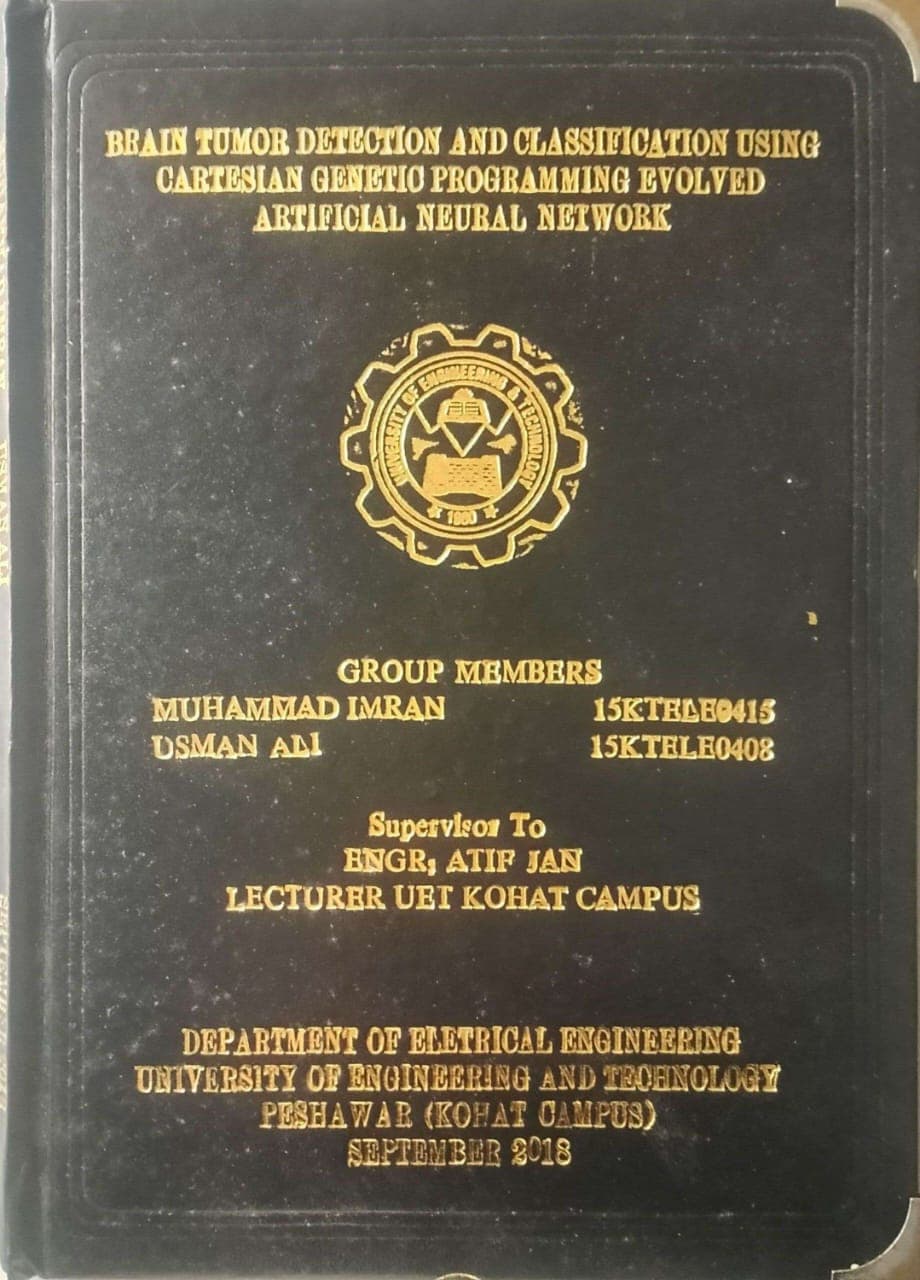
About the Project
Developed a brain tumor detection and classification system using Convolutional Neural Networks as my final year university thesis — applying deep learning to a real-world medical imaging problem.
The core objective was to build a model that could analyse MRI scan images and classify them into tumor categories with high accuracy, reducing the diagnostic burden on radiologists for initial screening. My approach followed the standard deep learning pipeline: dataset acquisition from Kaggle's publicly available brain MRI dataset, preprocessing and augmentation, model architecture design, training, and evaluation.
I experimented with CNN architectures of increasing depth, using techniques like dropout regularisation to reduce overfitting on the relatively small medical dataset. Data augmentation — random flips, rotations, and brightness adjustments — was applied to artificially expand the training set and improve generalisation. The model was built and trained using TensorFlow and Keras, with Scikit-learn used for evaluation metrics including classification report, confusion matrix, and ROC analysis.
The development environment was Jupyter Notebook within Anaconda, which allowed iterative experimentation with model configurations and immediate visualisation of training curves and sample predictions. This project gave me foundational knowledge of applied machine learning — understanding not just how to call model APIs but how training, validation, and evaluation work at a fundamental level.